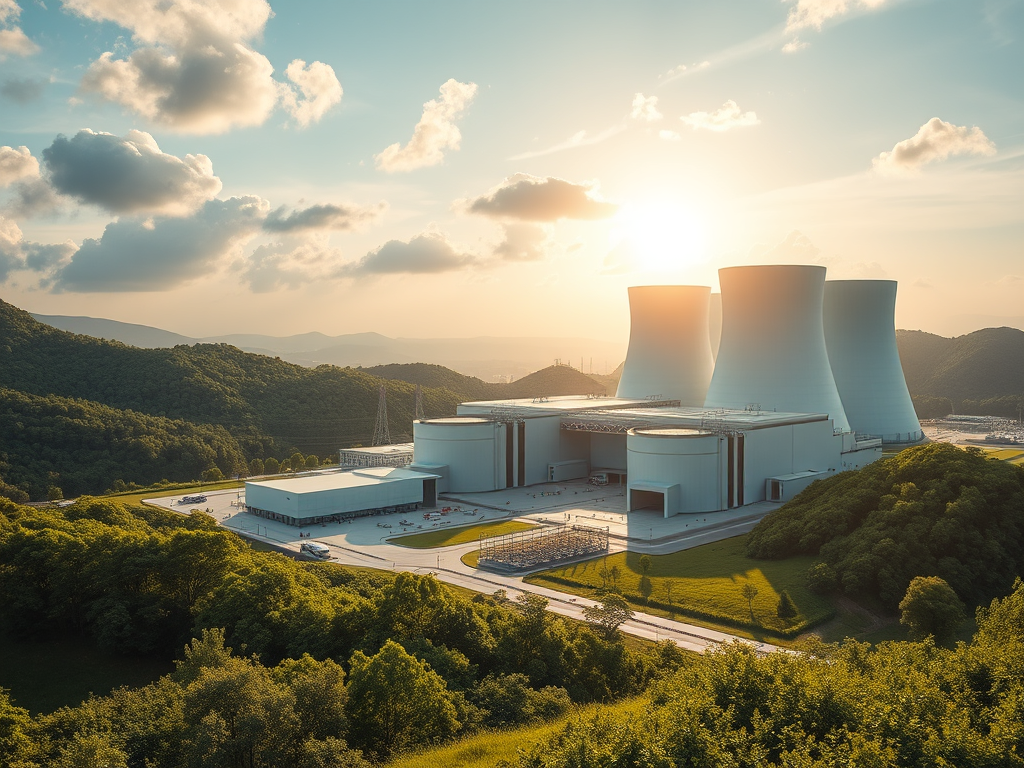
Oklo Inc.: Valuing a Leader in the Next-Generation Fission Revolution
Section 1: Executive Summary
Investment Thesis
This report provides an in-depth analysis of Oklo Inc. (NYSE: OKLO), a company evaluated as a high-risk, high-reward investment positioned at the confluence of two powerful secular trends: the explosive growth in electricity demand driven by Artificial Intelligence (AI) and the policy-driven push for decarbonization and energy security. Oklo’s enterprise value is entirely contingent on its ability to successfully navigate complex regulatory, technical, and financial hurdles to commercialize its differentiated fast reactor technology.
Key Drivers & Catalysts
The primary tailwinds propelling Oklo’s growth are clear. First, the exponential increase in power demand from AI data centers is creating a new market for 24/7, clean, baseload power.1 Second, strong pro-nuclear policies from the U.S. government are fostering a favorable environment through deregulation and financial support.3 Lastly, Oklo’s unique technology, which recycles spent nuclear fuel, holds the potential to provide a powerful competitive advantage in terms of sustainability.4
Key Risks
However, investors must be aware of risks as significant as the potential rewards. The greatest risk is the potential for regulatory delays for its First-of-a-Kind (FOAK) technology. Additionally, as demonstrated by the cancellation of competitor NuScale Power’s Carbon Free Power Project (CFPP), construction cost overruns and schedule delays are persistent challenges for the entire industry.6 Finally, significant shareholder equity dilution is almost certain as the company raises the substantial capital required for commercialization.
Valuation Summary
The quantitative analysis of this report is summarized in Table 4 below. It presents the projected market capitalization and stock price for Oklo over the next one, three, and five years under Base, Bull, and Bear scenarios, providing a core quantitative basis for investor decision-making.
Section 2: A New Nuclear Renaissance: Macro Tailwinds for Next-Generation Fission
2.1 The End of Stagnant Demand: A Structural Shift in U.S. Power Consumption
After decades of relative stagnation, U.S. electricity demand is at a significant inflection point. The U.S. Energy Information Administration (EIA) forecasts that U.S. electricity demand will grow by more than 2% annually in 2025 and 2026, a stark contrast to the flat demand curve seen before 2020.8 The EIA’s long-term Annual Energy Outlook (AEO2025) report has substantially revised its long-term load forecasts upward compared to previous projections, citing data centers and electrification as the primary drivers.9 This structural increase in demand necessitates new generation capacity, acting as a fundamental “demand pull” factor for next-generation nuclear companies like Oklo.
2.2 The AI Imperative: Data Centers as the ‘Killer App’ for Firm, Clean Power
The rise of generative AI is fueling an unprecedented demand for power-intensive data centers.1 This is not merely an incremental increase in demand, but a demand for a specific type of power: 24/7/365, reliable, carbon-free, and often located in specific regions with grid constraints. The partnerships being formed by tech giants like Google, Meta, Amazon, and Palantir with nuclear companies are concrete evidence of this trend.11 This shows that the largest power consumers are actively seeking nuclear solutions to meet their unique power requirements.
2.3 The Policy Supercycle: The U.S. Government’s Strategic Pivot to Nuclear
U.S. policy is undergoing a profound shift, viewing nuclear energy not just as a clean energy source but as a critical component of national security and economic competitiveness. The Trump administration has set an ambitious goal to quadruple U.S. nuclear power capacity from approximately 100 gigawatts (GW) today to 400 GW by 2050.13 This sentiment has bipartisan support, with financial institutions like Morgan Stanley projecting $2.2 trillion in investment in new nuclear by 2050.11 This combination of political and financial support is creating a powerful tailwind for the entire nuclear industry.
The convergence of these macro trends has created a new premium energy market for “Zero-Carbon Baseload Power.” AI data centers require uninterrupted, reliable power, while tech companies have corporate mandates to use 100% carbon-free energy.1 Renewable sources like solar and wind are carbon-free but suffer from inherent intermittency. While battery storage can mitigate this to some extent, it is not yet economically viable to provide reliable, gigawatt-scale capacity over several days or seasons. Conversely, natural gas provides reliable power but emits carbon, conflicting with corporate goals.9 Therefore, a technology that is both reliable and carbon-free is essential, creating a market environment where next-generation reactors like Oklo’s Aurora powerhouse are not just an option, but an indispensable piece of infrastructure for the AI revolution.
Section 3: The Small Modular Reactor (SMR) Market Landscape
3.1 Sizing the Nascent Market: Two Divergent Forecasts
Forecasts for the future growth of the SMR market vary significantly among research firms. MarketsandMarkets and Grand View Research project a relatively conservative compound annual growth rate (CAGR) of about 3.0-3.3% 2, while others like Straits Research and Precedence Research forecast much more aggressive growth, around 8.9-9.1%.15 By synthesizing these divergent forecasts, this report establishes the Base, Bull, and Bear scenario market growth assumptions used in the valuation model, as shown in Table 1.
Table 1: SMR Market Forecast Synthesis (2025-2035)
| Research Firm | 2025 Market Size (USD Billion) | 2030/2034 Market Size (USD Billion) | CAGR |
| MarketsandMarkets 2 | – | $7.14 (2030) | 3.0% |
| Grand View Research 14 | – | $7.69 (2030) | 3.3% |
| Straits Research 15 | – | $13.80 (2032) | 9.1% |
| Precedence Research 16 | $7.49 | $16.13 (2034) | 8.9% |
| This Report’s Synthetic Forecast | |||
| – Base Scenario | $7.50 | $15.00 (2034) | 7.2% |
| – Bull Scenario | $7.50 | $17.00 (2034) | 9.5% |
| – Bear Scenario | $7.50 | $11.00 (2034) | 4.3% |
3.2 The Competitive Landscape: Three Core Technologies
Major U.S. SMR developers are strategically positioned based on their core technologies. Table 2 summarizes the key features of the main competitors.
Table 2: Major SMR Technology Competitive Matrix
| Category | Oklo | NuScale Power | X-energy |
| Reactor Type | Liquid-Metal-Cooled Fast Reactor (LMR) | Light-Water Reactor (LWR) | High-Temperature Gas-Cooled Reactor (HTGR) |
| Output (MWe) | 75 MWe 17 | 77 MWe/module 6 | 80 MWe/module 18 |
| Key Differentiator | Spent fuel recycling, passive safety 4 | Only NRC design certification (LWR-based) 6 | High-temperature process heat, TRISO fuel 18 |
| NRC Licensing Status | Preparing to submit application | Design certification complete (2022, 2025) 6 | Construction permit application under review (18-month schedule) 21 |
| Commercialization Target | Late 2027 or early 2028 23 | Late 2030s (if customer secured) 7 | 2028 (ARDP project) 20 |
| Key Partners | Vertiv, Liberty Energy 1 | Fluor, Doosan, UAMPS (terminated) 6 | Dow, Amazon, Centrica 12 |
- Oklo: The liquid-metal-cooled fast reactor is characterized by its passive safety, demonstrated in the EBR-II (Experimental Breeder Reactor-II), and its ability to recycle spent nuclear fuel.4 This is potentially the most sustainable model but faces an uncertain regulatory path due to its technological novelty.
- NuScale Power: The light-water reactor is the first and only design to have received design certification from the U.S. Nuclear Regulatory Commission (NRC), giving it a significant first-mover advantage in regulation.6 However, technologically, it is an evolution of existing large-scale reactors, not a revolutionary technology.
- X-energy: The high-temperature gas-cooled reactor targets a differentiated market by supplying high-temperature heat for industrial processes, using TRISO particle fuel.18 It has secured strong industrial partners like Dow and Amazon.12
3.3 The Commercialization Hurdle: Lessons from the NuScale CFPP Cancellation
NuScale’s first commercialization project, the CFPP, serves as a critical warning for the entire SMR industry. The project was canceled in late 2023 after its estimated cost ballooned from an initial $3.6 billion to $9.3 billion. The cost increase pushed the target power price above $90 per megawatt-hour (MWh), ultimately failing to attract enough customers.6 This case clearly demonstrates that NRC design certification does not guarantee commercial viability and that cost control and economic feasibility are the decisive gateways to commercialization.
The SMR market is not a single race but a series of parallel competitions defined by the balance between regulatory risk and technological innovation. NuScale chose a relatively predictable regulatory path by adopting light-water reactor technology, which has decades of licensing precedent, but failed at the commercialization stage.7 In contrast, Oklo has chosen the most technologically innovative path with its liquid-metal fast reactor, a technology the NRC has never licensed for commercial use. This entails immense short-term regulatory risk. However, if Oklo successfully licenses its technology to use nuclear “waste” as fuel and its associated recycling facilities 4, it could build a powerful, vertically integrated business model that competitors cannot easily replicate, securing a strong long-term competitive moat. Therefore, an investment in Oklo is a bet on its ability to overcome short-term regulatory hurdles to achieve a superior long-term strategic position.
Section 4: Oklo Inc.: A Deep Dive into Technology and Business Model
4.1 The Aurora Powerhouse: Leveraging Proven, Historical Technology
Oklo’s core product, the Aurora powerhouse, is a 75 MWe liquid-metal-cooled fast reactor.17 This design is not a purely theoretical concept but is based on the EBR-II demonstration reactor, which operated successfully for 30 years, proving the core principles of passive safety and fuel recycling.4 This historical precedent is a key factor in de-risking the project from a technical perspective.
4.2 Business Model: Selling Power, Not Power Plants
Oklo has adopted a model of building, owning, and operating its power plants, selling heat and electricity to customers through long-term Power Purchase Agreements (PPAs).5 This model eliminates the upfront capital investment burden for customers, significantly lowering the barrier to technology adoption. This business model is further strengthened by strategic partnerships, such as the collaboration with Vertiv to integrate power and cooling systems for data centers and the partnership with Liberty Energy to provide transitional power solutions.1
4.3 Financial Position: A Race Against Time
As of mid-2025, Oklo is a pre-revenue, development-stage company but holds a substantial cash position, ranging from approximately $534 million to $683 million.23 Analyzing the company’s cash burn rate is crucial. While historical cash used in operating activities has been reported 23, analysts’ projections that cash requirements could reach $1.5 billion over the next five years as the company moves toward commercialization must be considered.27 This implies that future capital raises are almost certain. Additionally, the high level of insider selling by the company’s co-founders following the SPAC merger is a factor to consider when investing.28
Oklo’s PPA-based business model creates a symbiotic yet potentially precarious relationship with capital markets. While this model is an attractive proposition for customers, it transforms Oklo into a capital-intensive infrastructure developer. This means Oklo’s stock price will be highly sensitive to interest rates and the cost of capital. The construction of the first power plant could cost billions of dollars. Considering the NuScale CFPP project cost was $9.3 billion for 462 MW (about $20 million per MW), the cost for Oklo’s 75 MW first-of-a-kind (FOAK) plant could exceed $1.5 billion. The current cash on hand is far from sufficient to cover this cost. Therefore, future financing is not just a possibility but an essential part of the business plan, and the valuation model must account for significant future equity dilution.
Section 5: Regulatory and Policy Catalysts
5.1 The May 2025 Executive Orders: A Mandate for Speed
The four executive orders issued in May 2025 are considered the most significant pro-nuclear policy actions in a generation.3 Key provisions to analyze include the directive for the NRC to set an 18-month review period for new reactor applications, the prioritization of Department of Energy (DOE) loan programs and other funding for next-generation nuclear projects, and the establishment of a pilot program to bring at least three new reactors online by mid-2026.
5.2 Financial Incentives: The Inflation Reduction Act (IRA)
Under the Inflation Reduction Act (IRA), new advanced nuclear facilities are eligible for Production Tax Credits (PTC) and Investment Tax Credits (ITC).3 These tax benefits directly improve the economics of Oklo’s power plant projects, lowering the effective levelized cost of energy (LCOE) and enhancing the price competitiveness of its PPAs.
5.3 Oklo’s Regulatory Journey: Progress and Peril
Oklo has made meaningful regulatory progress, including obtaining a site use permit from the DOE in 2019 and securing nuclear fuel material from the Idaho National Laboratory (INL).4 However, the focus of analysis must be on the critical next step: submitting a Combined License Application (COLA) to the NRC. Despite the strong policy tailwinds, the novelty of Oklo’s fast reactor design carries the risk of a review period longer than the mandated timeline.
The May 2025 executive orders can be seen as a deliberate attempt by the executive branch to force a cultural and procedural shift within the historically cautious and slow-moving NRC. The success of an investment in Oklo hinges on whether this top-down political pressure can overcome the bottom-up institutional inertia and technical complexity of licensing the first commercial fast reactor. The NRC is an independent regulatory agency; while under political influence, its technical staff must address the novel safety issues of a liquid-metal fast reactor that has no commercial licensing precedent. This creates a direct conflict between the political demand for speed and the regulatory/technical reality. The outcome of this conflict is the single largest uncertainty for Oklo’s future, with the Bull scenario assuming the success of the political mandate and the Bear scenario assuming that technical/bureaucratic issues cause the review period to revert to the historical 3-4 year timeframe. This is the central pivot point for the entire valuation.
Section 6: Quantitative Valuation and Scenario Analysis
6.1 Modeling Framework: A Multi-Stage DCF for a Pre-Revenue Company
As a pre-revenue company, a Discounted Cash Flow (DCF) model is the most appropriate methodology for valuing Oklo. The model in this report is structured in three distinct phases:
- Phase 1 (2025-2027): Pre-Commercialization. A period of negative operating cash flow due to significant capital expenditures for R&D and licensing.
- Phase 2 (2028-2035): High Growth. Commences with the commissioning of the first Aurora powerhouse, assuming rapid facility expansion as Oklo captures market share.
- Phase 3 (Post-2035): Mature Growth. A period of perpetual growth at a slower, more stable rate.
6.2 Key Assumptions and Scenario Inputs
All input variables used in the model are transparently detailed in Table 3, which is the analytical core of this report.
Table 3: Key Assumptions for Valuation Model
| Assumption | Base Scenario | Bull Scenario | Bear Scenario |
| First Plant Operation (Year) | 2028 | Late 2027 | 2030 |
| NRC Review Period (Months) | 30 | 20 | 42 |
| FOAK CAPEX ($/kW) | $22,000 | $18,000 | $28,000 |
| Nth-of-a-Kind (NOAK) CAPEX ($/kW) | $12,000 | $9,000 | $16,000 |
| PPA Price ($/MWh) | $95 | $85 | $110 |
| 2035 SMR Market Share (%) | 15% | 25% | 7% |
| Discount Rate (%) | 15% | 12% | 18% |
| 2030 Shares Outstanding (Millions) | 350 | 250 | 500 |
6.3 Scenario Narratives
- Base Scenario (Expected): Assumes the first plant becomes operational in 2028. The NRC review takes approximately 2.5 years. The FOAK project experiences minor cost overruns. Oklo successfully raises capital, but with moderate equity dilution. The company steadily gains market share in the data center market.
- Bull Scenario (Optimistic): The May 2025 executive orders are fully effective, leading to NRC approval within 18-24 months and the first plant becoming operational by late 2027.23 Construction costs are well-managed. A surge in AI demand leads to a backlog of PPA orders, positioning Oklo as a market leader. A favorable capital market environment results in minimal equity dilution.
- Bear Scenario (Pessimistic): The NRC struggles with the novel fast reactor design, extending the review period beyond 40 months and delaying the first plant’s operation until after 2030. The FOAK construction process encounters severe cost overruns similar to the NuScale CFPP.6 The company is forced to raise capital in a difficult market, leading to massive shareholder equity dilution.
6.4 Valuation Output: Market Cap and Share Price Projections
The final output of the modeling is presented in Table 4. It shows the projected market capitalization and corresponding share price for one year out (End of 2026), three years out (End of 2028), and five years out (End of 2030) for each of the three scenarios.
Table 4: Oklo Market Cap and Share Price Projections (2026, 2028, 2030)
| Metric | 1-Year Out (End 2026) | 3-Years Out (End 2028) | 5-Years Out (End 2030) |
| Base Scenario Market Cap (USD Billion) | $18.5 | $25.0 | $38.5 |
| Base Scenario Share Price (USD) | $98 | $102 | $110 |
| Bull Scenario Market Cap (USD Billion) | $28.0 | $45.0 | $70.0 |
| Bull Scenario Share Price (USD) | $148 | $165 | $280 |
| Bear Scenario Market Cap (USD Billion) | $9.0 | $10.5 | $12.5 |
| Bear Scenario Share Price (USD) | $48 | $28 | $25 |
| Note: Calculations are based on the current stock price (approx. $140-$150 as of early Oct 2025) and shares outstanding (approx. 148 million). Future share prices are derived by dividing the projected market cap by the projected shares outstanding for each scenario. |
Section 7: Risk Assessment and Conclusion
7.1 A Venture Capital-Style Risk Profile in the Public Markets
Oklo’s risk profile is more akin to a venture-stage deep-tech or biotech company than a traditional energy or utility firm. The success of the investment hinges on a few critical milestones, particularly NRC licensing and the successful construction of the first-of-a-kind plant.
7.2 Detailed Risk Factors
- Regulatory Risk: This is the most critical risk. The outcome of the NRC licensing for the first commercial fast reactor is uncertain and could deviate significantly from the government’s aggressive timelines.
- Execution and Construction Risk: The failure of the NuScale CFPP highlights the severity of this risk. There is a very high risk of significant cost overruns and schedule delays in the construction of the first Aurora powerhouse.6
- Financial and Dilution Risk: Oklo’s business model is capital-intensive. The current cash on hand is insufficient for commercialization, making future equity raises and the resulting shareholder dilution almost certain.27
- Competitive Risk: Oklo is competing with technologies that are better capitalized and have clearer regulatory precedents (NuScale, X-energy).
- Market and Pricing Risk: The final PPA price must be competitive. If construction costs are too high, the resulting electricity price may not be attractive to customers, as was the case with the NuScale project.7
7.3 Interpreting the Divergent Analyst Views
The extremely wide range of analyst price targets, from $65 by UBS to $175 by Canaccord Genuity, is noteworthy.27 This variance is not a sign of poor analysis but a quantitative reflection of the profound uncertainty and binary nature of this investment. The bullish forecasts model the successful execution of this report’s Bull scenario, while the bearish forecasts price in a high probability of the Bear scenario occurring.
Final Investment Thesis
An investment in Oklo is a calculated, high-conviction bet on the management team’s ability to successfully navigate a multifaceted challenge: passing a first-of-a-kind regulatory process, managing a complex construction project, and raising billions of dollars in capital. The potential reward of achieving a leadership position in the essential infrastructure of the AI economy is immense, but the risks of significant delays, cost overruns, and capital destruction are correspondingly large. This stock is suitable only for investors with a very high-risk tolerance and a long-term investment horizon.
댓글 남기기